Global Market Review – May 2023

Currently reading

Global Market Review – May 2023

6 min read

Global Market Review – May 2023

We observed a continuation of several trends throughout May, including further stabilisation of banking sector risks, persistently high core inflation, and market leadership becoming increasingly concentrated into technology companies.

We observed a continuation of several trends throughout May, including further stabilisation of banking sector risks, persistently high core inflation, and market leadership becoming increasingly concentrated into technology companies. The US debt ceiling debate was also a key topic of focus for investors. The US government neared a deal to raise the federal debt limit at the end of the month, however risks remain in relation to the action that will be taken following an agreement of a deal.

Picture1.png

Data from Refinitiv, 1 June 2023

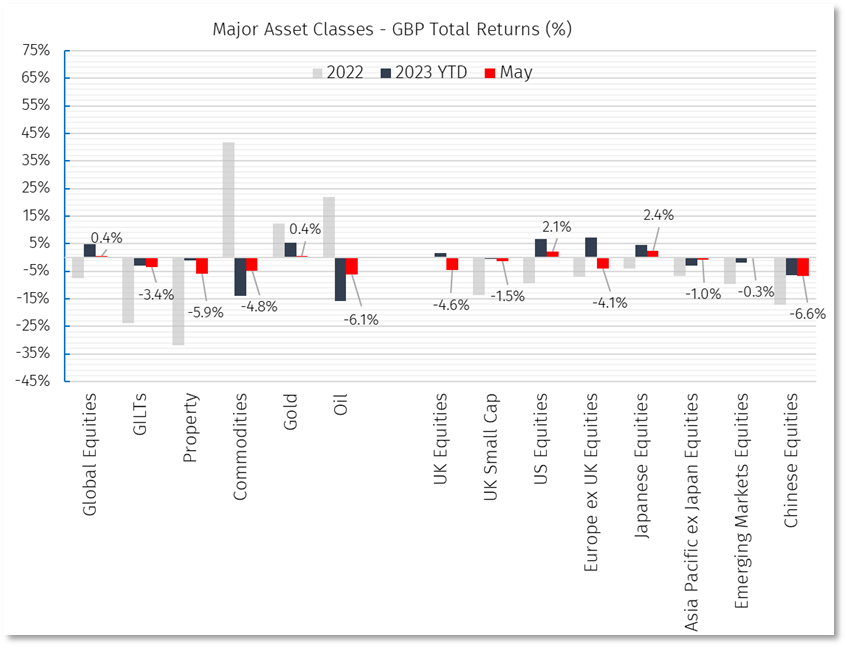
US and Japan were the standout performers in global equity markets. Mega-cap technology companies accounted for nearly all returns of the US equity market, which have rallied strongly in response to earnings and a growing investor enthusiasm on the future potential of Artificial Intelligence (AI). Improving optimism on corporate governance, a weaker yen, and signs that the country is emerging out of deflationary stagnation have all been positive factors for Japanese equities, which continue to see more attractive valuation levels within developed markets. Europe gave back some gains over the month but remains the strongest region for the year, however China was the main laggard releasing weak economic data on consumer spending and manufacturing which was published during the month. Solid gains from other emerging market countries, including Brazil and India, counterbalanced the China detraction resulting in global emerging markets ending the month flat in sterling terms.

Major asset classes outside of equities broadly detracted over the month. With sticky inflation remaining a particular issue for the UK economy, gilt yields reached levels not seen since the ‘mini-budget’ debacle of September last year. The All Stocks Gilt Index ended the month down 3.4%. We saw some pockets of recovery within property with some encouraging corporate activity during May, however the headwind of higher yields contributed to a 5.9% decline. Commodities were a mixed picture with the oil price and industrial metals continuing to sell off but gold holding up better at around flat for the month.

While we agree that breakthroughs in AI have the potential to increase revenues and earnings for monopolistic technology companies, valuations matter, and it is unlikely one sector can continue to dominate performance for a sustained period with valuations at current levels. With this in mind, we maintain a diversified approach in this environment, across industries and investment styles. Economic conditions appear to be weakening and we take the view that global recessions have been postponed rather than avoided. Despite this, the economy is not the market, and we continue to see attractively valued investment opportunities with favourable prospects for the long term. 

UK

Sector performance was almost a mirror image of the previous month, with all sectors other than technology (flat) detracting in May. Energy and consumer defensives were the largest detractors (detracting 1.3% each). BP (-14.2%) and Shell (-8.6%) moved with energy prices and Unilever (-8.4%) saw some profit taking after a steady year of positive performance.

UK headline inflation for April fell less than expected, falling from 10.1% to 8.7% (forecast 8.5%). Even more of a cause for concern for the Bank of England, core inflation, which excludes energy and food prices, increased from 6.2% to 6.8% in April. Manufacturing PMI’s fell from 47.8 in April to 46.9 in May. Service activity held up better with the Services PMI only down from 55.9 to 55.1. The unemployment rate rose slightly from 3.8% to 3.9% in March while jobless claims reached the highest level since early 2021. Markets are now pricing in two further interest rate hikes from the Bank of England and believe rates will peak slightly above 5% in the coming months.

Europe

European equities lagged for the month (-4.1%) but remain one of the strongest performers of the year. The lower exposure to technology was the main factor in relative underperformance to other developed markets such as US and Japan. Leading chip-making equipment manufacturer ASML was the only notable contributor to the index performance (returning +14.7% and contributing +0.46%). Continued weakness in goods demand impacted sentiment for consumer stocks, with luxury goods companies Kering (-14.4%) and LVMH ( -8.5%), and consumer staples L’Oreal (-9.7%) and Nestle (-7.0%) leading the regional detraction.

Latest PMIs suggest the Q1 rebound in business activity has faded. Revisions to German GDP data revealed that the country experienced a recession over the winter. Eurozone countries started to show signs of disinflation, with declines in annual inflation rates in France, Germany, and Spain. Overall, headline inflation increased marginally by 0.1% to 7.0%, however core inflation decreased slightly from 5.7% to 5.6% year-on-year as a rise in services inflation was offset by a move down in core goods price inflation. Food prices, which have remained stubbornly expensive saw signs of cooling, with prices declining 1.9% to 13.5% year-on-year. The ECB slowed the pace of rate hikes increasing the main deposit rate to 3.25%, but signalled more tightening is to come.

US

The surge in technology companies was led by Nvidia (+38.3%) which released results towards the end of the month. The company’s revenue was significantly higher than expected due to increased demand for its semiconductors, which most AI projects rely on. Revenue of $11bn was forecast for the second quarter, versus the consensus figure of $7.2bn. Technology and AI related companies continue to carry the US equity market, with the sector contributing a 2.8% return over May, while 72% of other sectors were in negative territory. Energy was the weakest performer with Exxon Mobil (-11.7%) and Chevron (-8.5%) leading detractors for May.

At the end of the month, Joe Biden and Republican House Speaker McCarthy agreed to suspend the US debt ceiling for two years. A key condition of the compromise was for non-defence government spending to be roughly flat until fiscal 2024. Although the probability of further gridlock or even a default was low, the agreement will bring some comfort to investors. Despite this, is important to consider the risks that follow the raising of the debt ceiling, including the possibility that Treasury bill issuance may have consequences for liquidity in other markets. Credit rating agency Fitch has also warned it could still cut its US debt rating even after the deal as repeated political standoffs have lowered confidence on fiscal and debt matters.

Economic data presented a mixed picture. April saw stronger-than expected auto sales, housing starts and employment numbers, however the ISM Manufacturing PMI continued to contract, with the new orders sub-index falling to 42.6. The labour market remained tight, with the unemployment rate moving lower to 3.4%. US inflation rose slightly in April, with headline and core CPI (consumer price index) both rising 0.4% month-on-month. This was partly due to the higher prices of gas and used vehicles, both of which have seen more recent reversals. This suggests that the rise is likely to only be a temporary pause on the road to lower levels. The Federal Reserve raised its target rate range by 25bps 5.25% on 3rd May with consensus at the time suggesting this could be the final hike. However, the probability of further tightening has increased throughout the month, with the futures market indicating an above 60% probability of a June hike at the end of May.

Japan

Japanese equities are one of the top performers year-to-date, with the TOPIX rising 2.4% in May. Semiconductor companies were also a key contributor to performance here with Avantest Corp (+67.9%) and Tokyo Electron (+23.2%) notable performers. Broader sectors held up well, with consumer defensives the only detractor for the month (-0.2%). Improving corporate governance standards and strong foreign buying continue to be factors supporting returns.

Economic data appeared resilient. GDP rose 1.3% year on year, driven by strong private consumption and services PMIs rose to a record high. Core inflation increased to 4.1% year on year, which is Japan’s highest reading since 1981. Improving corporate governance standards and strong foreign buying have supported returns year-to-date.

Asia ex Japan and Emerging Markets

Chinese companies featured heavily in the main detractors for Asia and Emerging Markets as the country lost momentum following the reopening boost. The Shanghai Shenzhen CSI 300 index ended the month down 6.6%, which overshadowed stronger performance from Taiwan (+7.3%), India (+4.0%) and Brazil (+3.1%). Again, anticipated beneficiaries from the AI trend dominated returns in both Asia ex Japan and Emerging Markets indices, with technology the sole positively contributing sector in each index. Quanta Computer (+37.6%), MediaTek (+15.8%) and Taiwan Semiconductor Manufacturing Company (+12.8%) were notable performers in the technology space. Electric vehicle producer Li Auto (+25.8%) was also a standout performer. China has also seen auto exports surge with recent data revealing that the country surpassed Japan as the world’s largest auto exporter in the first quarter of the year.

Economic data indicated a slowdown in activity for China. Considering base effects from last year’s weak figures, industrial production growth of 5.8% and a 7.9% drop in imports were received negatively by the market. Services PMI remained healthier at 56.4, however manufacturing PMI fell to a five-month low of 48.8.

Latin America continues to outperform other Emerging Markets, with inflation falling rapidly. Mexico's Central Bank ended its hiking cycle but communicated it will keep rates on hold for a while. We have not seen interest rates cut yet in Brazil, however analysts have lowered interest rate forecasts and the consensus is an easing cycle beginning in September with a quarter-point reduction.

Fixed Interest

Against the stubbornly high inflation backdrop, yields on bonds rose, leading to a return of -1.9% for global bonds. We believe that slowing growth and the lag effects from recent rate rises should eventually lead to lower yields, however central banks remain aggressive shorter-term, and conditions are expected to remain volatile in the months ahead.

Gilts were one of the worst performers within government bonds, with 2-year and 10-year gilt yields increasing by 55bps and 46bps respectively. Better than expected inflation prints helped European bonds outperform with most eurozone members seeing slight declines in yields over the month (Italy -0.10%, France -0.04%, Germany -0.03%,). Corporate credit spreads remain relatively tight and still do not reflect general risks in the economy.

Property and Alternatives

Following a stronger April (+6.4%), the UK Commercial Property sector was back in negative territory last month, with the FTSE EPRA NAREIT UK Index returning -5.9%. Sub-sector performance was mixed, however over 70% of REITs derated throughout the month, challenged again by the headwind of rising yields. Brighter spots included UK Residential which performed well due to Civitas Social Housing’s takeover bid, which was at a 44.4% premium to the company’s closing price on 5th May. Other encouraging corporate activity for the sector included an agreement for an all-share offer of CT Property Trust from LondonMetric, which represented a 34.3% premium to the share price. We see this corporate activity as a positive sign in demonstrating value, in a sector that has recently seen a perfect storm of headwinds.

Rising yields also put pressure on direct infrastructure and renewables trusts, with the sectors returning an average of -3.3% and -3.2% respectively over May. 3i Infrastructure trust held up better following strong results on 10th May and ended the month flat. The trust delivered a 14.7% return throughout the last year, with portfolio companies benefitting from direct contract indexation and strong market positions providing pricing power.

Oil prices fell 6.1% (8.6% in dollar terms) with uncertainty around China demand. The oil price fell back below $70 during the month, a level that had previously provoked an earlier reaction from OPEC+. At the time of writing further cuts have been announced following an OPEC+ meeting on 4th June, with Saudi Arabia cutting oil production by 1mn barrels a day. Industrial metals also suffered from uncertainty about Chinese demand, with copper continuing to detract another 5.2% for the month. Gold broke the $2,000 per ounce psychological barrier again early in May and was close to testing all-time highs but has been in a period of consolidation since then.

The value of investments can fall as well as rise and you might get back less than you invest. Past performance is not a reliable indicator of future performance.